Unseen Influences – Part 12/12
What Is an Energy Field? Are Science, Spiritual Traditions, and Bioenergy Talking About the Same Thing?
Are ECG, EEG, biomagnetic fields, aura, and bioenergy the same concepts? Let us separate measurable physiology from spiritual energy language without conflating them.

Heart to heart, warm greetings…
When we say “energy field,” we may mean the heart's measurable electrical activity, the feeling a place gives us, or spiritual concepts such as aura and bioenergy. Because we use the same phrase, these areas are easily confused.
I do not use science to silence spirituality, or spirituality to fill gaps in science. Trust grows when we call what can be measured measurable, personal experience experience, and matters of belief and meaning spiritual interpretation.
“Our love of truth can remain deep without confusing our words.”
The phrase “energy field” is used in very different senses today. A physicist thinks of the electromagnetic field; a physician may speak of the heart’s or brain’s electrical activity; a spiritual teaching may mean aura or life energy.
The problem begins when these different concepts are used as proof of each other in a single sentence: an inference like “The heart has an electromagnetic field, therefore aura is scientifically proven” misrepresents both science and spiritual approach.
In this final piece of the Unseen Influences series, we will place these concepts side by side without conflating them.
Short Answer: We Use the Same Word, but We Don’t Mean the Same Thing
The human body has measurable electrical activity. Electrocardiogram (ECG/EKG) is used to record the heart’s, and electroencephalogram (EEG) the brain’s electrical activity. [1][2]
Electric currents are associated with magnetic fields; the heart’s extremely weak magnetic field can be recorded through magnetocardiography using special sensors. [3]
These are real, measurable biophysical phenomena. But they do not automatically prove the existence of aura, prana, qi, or the bioenergy field from spiritual traditions.
1. What Does “Energy” Mean in Science?
In physics, energy is a measurable quantity related to the capacity to do work and is expressed in units like joules. It has forms such as electrical, chemical, kinetic, or thermal energy.
In everyday language, when we say “my energy is high” or “that person’s energy is warm,” we are not measuring joules. We are talking about vitality, emotion, social impact, or an intuitive experience.
This is the first key distinction: the same word carries different meanings in different contexts.
2. Is the Heart’s Electrical Activity Really Measured?

Yes. ECG/EKG records the heart’s electrical activity. The electrical excitation of the heart muscle produces signals that can be measured with electrodes placed on the body surface. MedlinePlus describes ECG as a test that measures the heart’s electrical activity. [1]
This measurement is used clinically for rhythm and many cardiac assessments. However, what ECG measures is not “emotional aura.”
3. Is the Brain’s Electrical Activity Also Measured?
Yes. EEG records signals related to electrical activity in the brain through electrodes placed on the scalp. MedlinePlus defines EEG as a test that measures the brain’s electrical activity. [2]
It can be used in sleep, epilepsy, and other neurological assessments. The same boundary applies: EEG measures brain electrical activity; it does not measure the spiritual “frequency” of thought or aura colour.
4. Does the Heart Have a Magnetic Field?
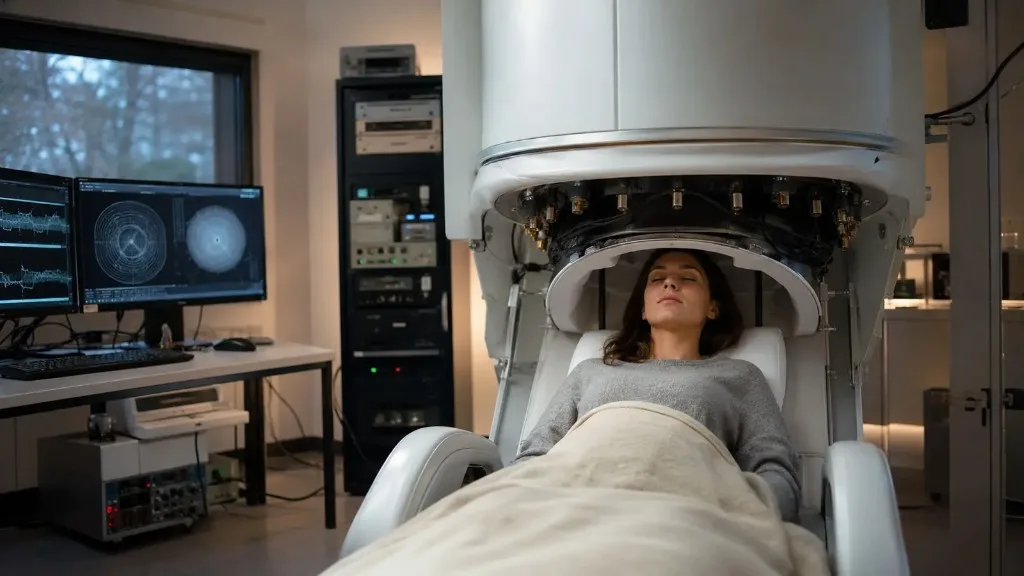
Yes. The heart’s electrical activity generates a very weak magnetic field. Magnetocardiography is a non-invasive method that attempts to record this field with extremely sensitive sensors. This technology has been studied in the biomedical literature for a long time. [3]
But the signal measured here is a very weak biomagnetic phenomenon requiring special equipment. This fact does not show that one person magnetically manages another’s emotions from metres away.
5. So What Is Aura?

Aura is a concept used in various spiritual and esoteric traditions to describe a subtle energy field thought to surround a person. Layers, colours, and functions may vary from tradition to tradition.
Aura is not defined in modern medicine as an accepted anatomical structure or standard measurable biophysical field. Personal experiences like “I saw an aura” are the person’s lived experience; but they are not the same type of evidence as scientific measurement.
6. What Is Bioenergy, and in What Sense Is “Energy” Used Here?
The word bioenergy can be used in different contexts. In biology, “bioenergetics” is a scientific field studying energy transformations in living organisms. In Turkey and in spiritual practice, “bioenergy” often refers to practices thought to work with a person’s energy field through hands or intention.
These two uses are not the same. Therefore, when “bioenergy” is used in Angels Akademi content, it should be clear which meaning is intended.
NCCIH’s current information page on Reiki states that there is no scientific evidence supporting the existence of the energy field assumed to play a role in Reiki. This does not mean all spiritual experiences are worthless; but it keeps the evidence boundary clear for health claims. [4]
7. Why Is Electromagnetism Not Proof of Aura?
Logically, two separate propositions need to be distinguished:
• The human body has electrical activity: yes, it is measurable.
• This electrical activity is associated with very weak magnetic fields: yes, they are measurable.
• Spiritual aura is the same as this measured field: there is no accepted scientific evidence demonstrating this.
The truth of the first two statements does not automatically make the third true. This distinction is one of the most important trust principles of the new blog strategy.
8. Why Does the Word “Frequency” Cause Confusion?
In science, frequency expresses the number of repetitions of an event per unit time and is measured in hertz (Hz). We can speak of the frequency of sound waves, electrical signals, or electromagnetic waves.
In spiritual language, when “high-frequency person” is said, a moral, emotional, or spiritual quality is usually being described. This usage may be metaphorical; it should not be assumed to have a physical Hz value.
If claims like “100,000 MHz healing frequency” are used, it should be explained what exactly is at 100,000 MHz, how it was measured, and what evidence exists. Otherwise, scientific terminology is being used as decoration.
9. Do We Have to Turn Spiritual Traditions into Science?
No. The meaning of a spiritual tradition does not have to be translated into laboratory language. Prayer, meditation, ritual, or energy work can be meaningful for a person; there is no need to misuse quantum physics to defend that meaning.
NCCIH evaluates complementary approaches through evidence, safety, and their relationship to conventional healthcare. [5]
A more trustworthy language is: “This practice is interpreted this way in the bioenergy/spiritual approach; scientifically, this part has been measured, this part has not been demonstrated.”
10. The Angels Akademi View: Separating Three Languages

At the end of this series, we can summarise the content standard we propose for Angels Akademi in three columns:
1. Scientific language
Phenomena that can be measured, tested, and referenced, such as ECG, EEG, stress physiology, emotional contagion, sleep, and environmental psychology.
2. Experiential language
What a person genuinely feels: “I feel constricted in this room,” “I was exhausted after that meeting,” or “I can't be myself around this person.” The experience is real; its explanation is investigated separately.
3. Spiritual/bioenergetic language
Traditional or practice-specific concepts such as aura, energy field, chakra, intention, and the energy of a space. They are discussed in their own context, not labelled as scientific findings.
This distinction does not diminish Angels Akademi’s spiritual identity. On the contrary, it creates a more trustworthy brand language that knows which claim it is making in which domain.
11. Seven Questions to Evaluate a Claim About Energy Fields
• Is the word “energy” being used physically, metaphorically, or spiritually?
• If measurement is claimed, which device and unit were used?
• Is the source a peer-reviewed study or a personal experience?
• Is there a logical leap from a biophysical measurement to a spiritual conclusion?
• Is there a health or treatment promise?
• Have alternative explanations been considered?
• Is scientific uncertainty stated openly?
The Three Distinct Languages of Energy
• Scientific language discusses physical quantities with definitions, measurement methods, and units.
• Everyday experiential language uses metaphors such as “This room has good energy” or “I have no energy today” to summarise mood, bodily state, and social atmosphere.
• Spiritual language uses concepts of personal belief and practice such as aura, life energy, intention, bioenergy, and spiritual fields.
None of these languages automatically invalidates the others. Presenting a concept from one language as proof in another, however, can mislead. ECG genuinely records the heart's electrical activity; that does not mean ECG proves a spiritual aura.
Five Checks When You Hear an Energy Claim
1. Is “energy” being used in a physical, everyday, or spiritual sense?
2. If measurement is mentioned, are the device, unit, and method clear?
3. Is a personal experience being presented as a scientific conclusion that applies to everyone?
4. Does the practice promise to replace medical treatment?
5. Are fear, certainty, or pressure to pay a high price influencing my decision?
These questions do not diminish spiritual experience; they protect the boundaries of health, ethics, and accurate information.
12. Common Mistakes
Mistake 1: The heart’s electromagnetic field means aura.
No. The heart’s electrical and magnetic activity are measurable biophysical phenomena; aura is a spiritual concept.
Mistake 2: EEG measures the spiritual frequency of thought.
No. EEG records signals related to brain electrical activity from the scalp.
Mistake 3: Science does not accept anything unseen.
Wrong. Science measures many things not directly visible to the eye through indirect or direct instruments. Measurement method and testability matter.
Mistake 4: If there is no scientific evidence, the experience is definitely fake.
No. Personal experience can be a real lived experience. But what explains that experience is a separate question.
Conclusion: Clarifying the Word “Energy” Clarifies the Entire Series
In the Unseen Influences series, we discussed many experiences from human relationships to spaces, from tiredness to family patterns. The common problem was often the same: interpreting a real experience too quickly with a single explanation.
The same care is needed with the energy field concept. We can honestly describe the body’s electrical and biomagnetic processes. We can also discuss spiritual aura and bioenergy concepts in their own traditional context. But we should not make one the proof of the other.
Trustworthiness comes not from trying to make everything look scientific, but from clearly stating what is known, what is interpreted, and what is experienced.
If You Want to Deepen This Journey
Previous part: What Is a Personal Boundary and Why Does It Protect Our Energy?
Part 11: What Is a Personal Boundary and Why Does It Protect Our Energy?
To hear Maria Öcal discuss this subject in her own words, visit the Angels Akademi YouTube channel; for short practices and new posts, follow Angels Akademi on Instagram.
Visit the Angels Akademi YouTube channel
Follow @angelsakademi on Instagram
If you would like to explore your inner world more deeply through notes, questions, and intentions, discover the book The Light Never Went Out.
Discover The Light Never Went Out
Return to the first article in the series
Frequently Asked Questions
Does the human body have an electromagnetic field?
Electrical activities in the human body are associated with extremely weak magnetic fields; heart-originated biomagnetic signals can be measured with special sensors. [3]
Has aura been scientifically proven?
Aura is a spiritual concept and has not been demonstrated as an accepted human energy field in standard scientific measurements. NCCIH states there is no scientific evidence supporting the existence of the energy field assumed in Reiki. [4]
What do ECG and EEG measure?
ECG records signals related to the heart’s, and EEG to the brain’s electrical activity. [1][2]
Is bioenergy the same as bioenergetics in biology?
No. In biology, bioenergetics is a scientific discipline studying energy transformation in living organisms; in spiritual usage, “bioenergy” refers to a different practice tradition.
Are spiritual practices worthless without scientific evidence?
Personal meaning, ritual, and subjective experience are a separate domain. However, when health and treatment claims are made, effectiveness and safety evidence must be evaluated separately.
About the Author
Maria Öcal is the founder of Angels Akademi, an educator, and an author of The Light Never Went Out.
Sources and Editorial References
Related