Unseen Influences – Part 05/12
Can a House Really Feel “Heavy”?
Why can a place feel oppressive, tiring, or unsettling as soon as we enter? We distinguish environmental psychology, memory, the senses, and spiritual ideas of place energy.

Some houses settle us the moment we walk in. In others, even with no open problem, our chest tightens, we tire after a short time, or we want to go outside at once.
We sometimes describe this as “the house is heavy,” “the energy of this house is not good,” or “something here is pressing on me.” That language is strong for telling the experience; it does not, by itself, explain the cause.
The effect a house leaves on us can be a combination of many layers: from air quality to light, from smell to noise, from clutter to past associations, and the social atmosphere of the people who live there.
Spiritual traditions can interpret the same experience through the energy of a place, a trace, intention, or the language of a field. In this piece we will look at the two fields without mixing them.
Yes, a house can really feel heavy. Here, though, “heavy” is not a scientific unit of measure. It is a word that describes a person’s bodily and emotional experience.
Poor ventilation, temperature, humidity, smell, insufficient or uncomfortable light, constant noise, and dense visual clutter can reduce ease. When personal memories, past experience, and social tension are added, the effect can become more marked.
So the first approach should not be “there is negative energy in this house.” It should be: “Which visible and unseen elements here are affecting me?”
Indoor air is not only a matter of smell. The U.S. Environmental Protection Agency treats indoor air quality as a health and comfort issue related to pollutants inside and around a building. Insufficient ventilation can contribute to pollutants, humidity, and unwanted smells building up inside. [1]
Short Answer: Why Can a House Feel “Heavy”?
If after a few minutes in a room you feel a headache, sleepiness, a dense smell, or a sense of being stifled, physical conditions should be checked first. Opening a window, assessing ventilation, and looking at issues such as humidity or mould are practical steps that can come before “energy clearing.”
This does not dismiss a spiritual experience. On the contrary, setting aside environmental factors that can be explained makes observation more reliable.
Light does not only let us see; it can also affect processes related to alertness, the sleep–wake rhythm, and mood. Reviews of indoor light’s effects on human physiology and behaviour emphasise that intensity, timing, and spectral qualities can matter. [2]
1. Air Quality and Ventilation: The Most Visible Layer, and the One Most Often Skipped
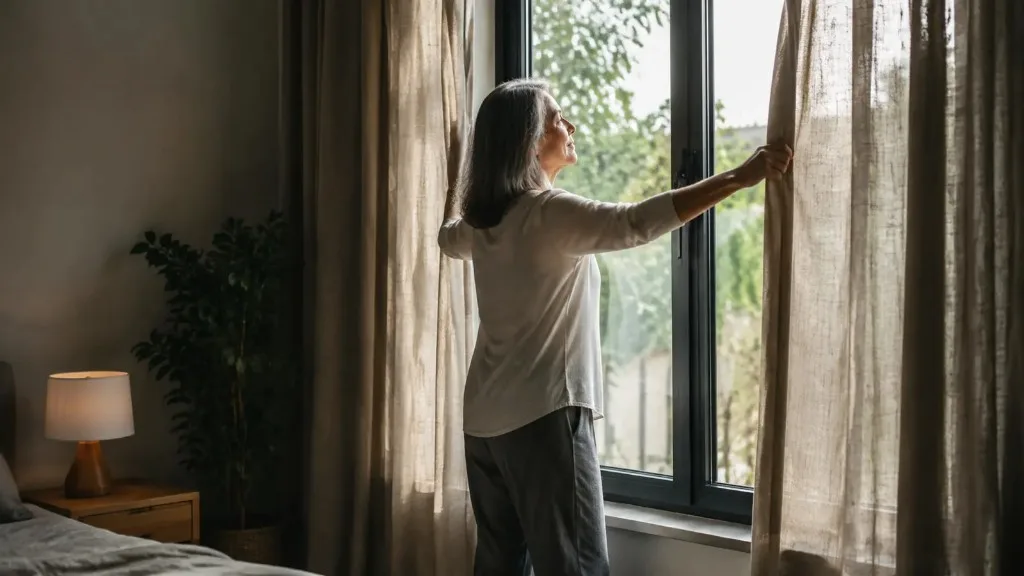
That is why the same room can feel open in morning light and tiring under hard, cold light at night. What we call “the atmosphere of the house changed” is sometimes, in a literal sense, a change in the lighting.
Not everyone lives order in the same way. For some, many objects create a warm, familiar atmosphere; for others they become visual cues that keep asking for attention.
In a study of the home environment, women who described their home more through “clutter” or “unfinished work” were reported to have more negative patterns of cortisol and mood across the day. That single study does not mean “clutter makes everyone ill”; it does show that how a home is perceived can relate to the experience of stress. [3]
2. Light, Rhythm, and Mood
So the feeling “this room tires me” can sometimes be not metaphysical, but the result of many objects, unfinished tasks, and visual cues constantly asking for attention.
Smell is a sense that can connect strongly with autobiographical memory. Research shows that personal memories triggered by smell can carry different emotional qualities and can sometimes be lived more vividly than other cues. [4][5]
3. Why Can Clutter Create Mental Load?

When you enter a house you may sense a smell like the furniture of a childhood home, a hospital corridor, an old relationship, or a hard period. The mind may not find the source at once; the emotional response can still appear.
So the feeling “there is something from the past here” can sometimes truly relate to your past; it does not mean the house objectively carries that memory. The place may be activating a trace in your memory.
How the people who live in a house speak to one another, how conflict is lived, whether there is constant criticism or fear, also shapes the experience of the place.
4. Smell, Memory, and “This House Reminds Me of Something”

The same living room can feel easing during a peaceful conversation and tight in the middle of an intense argument. In such cases, part of what we call “the energy of the house” can be the bodily and emotional association left by the social interactions lived in that place.
In spiritual and bioenergetic approaches, places are thought able to carry a “field” related to the feelings, intentions, and repeating experiences of the people who live there. In some traditions, cleaning, ventilation, prayer, intention, incense, or ritual are part of the relationship formed with a place.
This section is not a claim of scientific proof. “The energy of a place” is a spiritual model of interpretation. It should not be presented as the same thing as energy in physics or as measured electromagnetic fields.
5. A House Is Not Only Walls: Social Atmosphere
Rituals can, though, change a person’s attention, intention, and psychological relationship with a place. When claiming through which mechanism the effect forms, scientific and spiritual language should be kept apart.
In the Angels Akademi approach, a house feeling “heavy” should not be tied to a single cause. First environmental conditions, then the person’s bodily response, then social and emotional associations should be observed.
6. The Energy of a Place in Spiritual Traditions
A practical order can be this:
Check ventilation, temperature, humidity, smell, and light.
Notice visual load such as clutter, dense objects, and unfinished work.
7. The Angels Akademi View: Read the Place First, Then Interpret
Observe whom you meet in the space, and with which feelings.
Ask which memory or period of life this house recalls in you.
After all of that, evaluate the experience you still cannot explain inside your spiritual frame.
This order does not say “what you feel is wrong.” It helps you read what you feel more carefully.
No. Air quality, light, smell, noise, temperature, social tension, and personal associations should be evaluated first.
There is no scientific method that confirms that conclusion. Getting used to a new house, uncertainty, and sensory difference can also have a strong effect.
No. The ease can be real; we cannot determine the mechanism of that ease from this experience alone.
Safety, health, and environmental conditions should be evaluated first. If there is a suspicion of mould, gas, electrical or structural safety, or a serious air problem, support should be sought from the appropriate specialists.
8. Eight Questions for Observing a House
1. After I walk in, where in my body does the first change begin?
Breath, chest, shoulders, stomach, head, or a wish to move?
2. Does the feeling change when I open a window or go outside?
If it does, weigh the share of environmental conditions separately.
3. In which rooms is it more marked?
A single room, or the house as a whole?
4. Is there a link with light, sound, smell, or temperature?
Note visible sensory factors first.
5. Do I feel the same when I am alone in the house and when others are there?
If there is a difference, consider the share of social atmosphere.
6. Does this place remind me of a place or person from the past?
Do not take the first association as automatically true; only observe.
7. Do clutter or unfinished tasks keep alerting me?
Visual load can be part of the feeling of a “heavy house.”
8. Which of the changes I make actually brings ease?
Ventilation, light, order, or distance — tell apart what helps.
9. Common Mistakes
Feeling well or unwell in a house is not unimportant. Body and mind constantly evaluate the environment. A strong feeling is not, by itself, proof of a metaphysical cause.
Sometimes opening a window, changing the light, reducing unnecessary objects, or resetting social boundaries changes the experience clearly. Sometimes a past memory is noticed. Sometimes a person wants to form a new relationship with the place inside their own spiritual frame.
The strongest question is not only “what is in this house?” It is also “what is happening inside me in this house, and which change affects that?”
First observe the house’s physical and sensory conditions; then evaluate the emotional and spiritual relationship you have with the place.
First observe the house’s physical and sensory conditions; then evaluate the emotional and spiritual relationship you have with the place.
First observe the house’s physical and sensory conditions; then evaluate the emotional and spiritual relationship you have with the place.
First observe the house’s physical and sensory conditions; then evaluate the emotional and spiritual relationship you have with the place.
Conclusion: The Feeling of a “Heavy House” Can Be Data, but Not a Single Explanation
First observe the house’s physical and sensory conditions; then evaluate the emotional and spiritual relationship you have with the place.
Conclusion: The Feeling of a “Heavy House” Can Be Data, but Not a Single Explanation
Mistake 1: Every house that feels heavy has negative energy.
First observe the house’s physical and sensory conditions; then evaluate the emotional and spiritual relationship you have with the place.
Mistake 2: If I just moved, everything I feel is left by the previous residents.
First observe the house’s physical and sensory conditions; then evaluate the emotional and spiritual relationship you have with the place.
Mistake 3: If I felt easier after a ritual, energy was measured.
First observe the house’s physical and sensory conditions; then evaluate the emotional and spiritual relationship you have with the place.
Mistake 4: If a house feels heavy, it must be left at once.
First observe the house’s physical and sensory conditions; then evaluate the emotional and spiritual relationship you have with the place.
Conclusion: The Feeling of a “Heavy House” Can Be Data, but Not a Single Explanation
First observe the house’s physical and sensory conditions; then evaluate the emotional and spiritual relationship you have with the place.
First observe the house’s physical and sensory conditions; then evaluate the emotional and spiritual relationship you have with the place.
First observe the house’s physical and sensory conditions; then evaluate the emotional and spiritual relationship you have with the place.
Conclusion: The Feeling of a “Heavy House” Can Be Data, but Not a Single Explanation
First observe the house’s physical and sensory conditions; then evaluate the emotional and spiritual relationship you have with the place.
Why Do We Suddenly Feel Uneasy When We Enter a Space?
First observe the house’s physical and sensory conditions; then evaluate the emotional and spiritual relationship you have with the place.
Why Do We Feel Our Energy Drop Around Some People?
First observe the house’s physical and sensory conditions; then evaluate the emotional and spiritual relationship you have with the place.
How Is Negative Energy Cleared?
First observe the house’s physical and sensory conditions; then evaluate the emotional and spiritual relationship you have with the place.
Frequently Asked Questions
Why does a house feel heavy?
Air quality, light, smell, temperature, noise, clutter, social atmosphere, and personal memories can act together. Spiritual traditions can also add the interpretation of “the energy of a place.”
Can the energy of a house be measured scientifically?
If “the energy of a place” is used in a spiritual sense, there is no accepted scientific test that measures it. Physical features such as temperature, humidity, air pollutants, sound, and electromagnetic fields can be measured.
What does it mean if I feel easier when I open a window?
Airflow, temperature, smell, and sensory experience may have changed. That observation is a useful cue for weighing the role of environmental factors.
Why does smell bring old memories back?
There is research showing strong links between smell and autobiographical memory; particular smells can trigger feelings tied to past experience. [4][5]
Conclusion: The Feeling of a “Heavy House” Can Be Data, but Not a Single Explanation
First observe the house’s physical and sensory conditions; then evaluate the emotional and spiritual relationship you have with the place.
Sources and Editorial References
- 1. U.S. EPA — Introduction to Indoor Air Quality
- 2. Xiao Q, et al. — A review of the health effects of indoor lighting (2021)
- 3. Saxbe DE, Repetti R. — No place like home: home tours correlate with daily patterns of mood and cortisol (2010)
- 4. Herz RS. — The Role of Odor-Evoked Memory in Psychological and Physiological Health (2016)
- 5. Herz RS, Schooler JW. — A naturalistic study of autobiographical memories evoked by olfactory and visual cues (2002)
Related